
George H. W. Bush's
Visit to Cheyenne
President George H.W. Bush's Visit to Cheyenne
By Curtis Olson - Registrar, CFD Old West Museum
July 20, 1990
“I really do feel at home here.”
President Bush’s visit to Cheyenne was part of a larger trip around the entire American West, including a trip to a GOP fundraiser and the dedication of the Richard Nixon Presidential Library in California, a fundraiser in Idaho for U.S. Representative Larry Craig (R) (running for the U.S. Senate and winning), and an anti-drug event and fundraiser in Montana for Lieutenant Governor Allan Kolstad (R) (running for the U.S. Senate and losing). Cheyenne would be the final stop of this trip to the Western U.S. by Bush. This visit took place on the first day of Cheyenne Frontier Days™ in 1990, and since the state’s centennial celebrations had just concluded on July 10th, it was decided that CFD and the Wyoming Centennial Commission would both organize the parade and speech at the Capitol Building that would be part of Bush’s visit to the city. At the time of Bush’s visit, his approval rating as President had dropped to 50% by July 20, 1990.
In preparation for Bush’s visit to the city, the Secret Service understandably had to arrive early to scout out the locations that Bush would visit for potential threat areas, overwatch points, etc. One of these sweeps took place at the state Capitol Building, where Joe McKee was serving as one of the caretakers of the building. When Secret Service agents and the President’s advance party met Joe at the Capitol Building, Joe allowed them access to everything they needed, and they eventually found where to place agents and lookout positions for when the President would eventually arrive. However, when the Secret Service agents arrived, it was raining heavily in Cheyenne, and 4-5 of the agents had brought no rain gear with them. Due to this, the agents asked Joe where in town they could get adequate rain gear, so Joe drove these agents down to the Wrangler, where the agents then purchased the rain dusters that they desperately needed. In appreciation of his efforts, one of the agents gave Joe an official George Bush Presidential ballpoint pen. Joe was also issued a special lapel pin by the agents for him to wear, which would give him access to the VIP areas at the Capitol Building when President Bush visited and gave his speech.
However, threats to the President were not totally absent during this visit. On the day of Bush’s visit, a 34-year-old unemployed data processor visiting Cheyenne from New Hampshire, Gregory Joseph Hill, was arrested on charges of making a threat to take the life of the President after he twice told a man in a Cheyenne bar two days earlier that “I’m here to shoot the President”. In his initial appearance in court, Hill told U.S. District Judge Clarence Brimmer that he didn’t even know Bush was going to be visiting Cheyenne and that he didn’t realize the seriousness of his actions, claiming he wasn’t normally a violent person. The judge then said he believed Hill was probably not a threat and seemed genuine in his statements, but still would take no chances and ordered Hill to be held without bond in the Laramie County Jail until President Bush’s visit to the city had concluded, after which Hill would be given a bail hearing and later have to have his felony charge go to trial.
President Bush departed Billings Logan International Airport at 11:10 AM on July 20. By 12:21 PM, Bush landed and arrived at the Wyoming International Guard Base in Cheyenne. Bush then exited Air Force One wearing a tan raincoat, knowing that the day was overcast and rainy in Cheyenne. The weather that day in fact was so overcast with low cloud cover that planes were turned away from the Cheyenne Airport earlier in the day until 10:00 AM, when the cloud cover cleared enough to allow flights to land. (Among the flights turned away and delayed from Cheyenne that morning was the plane that carried U.S. Congressman from Wyoming Craig Thomas (R) aboard, delaying his flight to Cheyenne, but still eventually getting him to Cheyenne just in time to meet President Bush on the tarmac). Under his raincoat, Bush also wore an open-collar shirt, a blue jacket (with his name and the Presidential seal embroidered into it), khaki pants and black cowboy boots, along with a Texas belt buckle that he would later show off to reporters in Air Force One during the flight back to Washington D.C. (after leaving the airport, Bush would take off his rain coat and not use it or an umbrella for the rest of the visit). On the tarmac, he greeted a series of local dignitaries and politicians at 12:30 PM, including Governor Mike Sullivan (D), U.S. House Representative Craig Thomas (R), U.S. Senator Malcolm Wallop (R), and (very enthusiastically) U.S. Senator and friend Al Simpson (R). Also on the tarmac to greet Bush was the mayor of Cheyenne, the commander of the Wyoming Air National Guard, the State GOP Chairman, the owner and hotel manager of the Hitching Post Inn, and the director of the Cheyenne Botanical Gardens (among other dignitaries), which had been awarded Bush’s 83rd “Daily Point of Light Award” back on March 6 of that year. At 12:35 PM, Bush left in his motorcade from the tarmac to get to the staging area on 22nd Street for his parade to the Capitol Building. Bush arrived at the staging area at 12:40 PM, where he met the General Chairman of CFD Jerry Jessen and Dick Hartman, the chairman of the Wyoming Centennial Commission. At the staging area, Bush boarded the truck that he would be riding and the parade got underway at 12:52 PM.
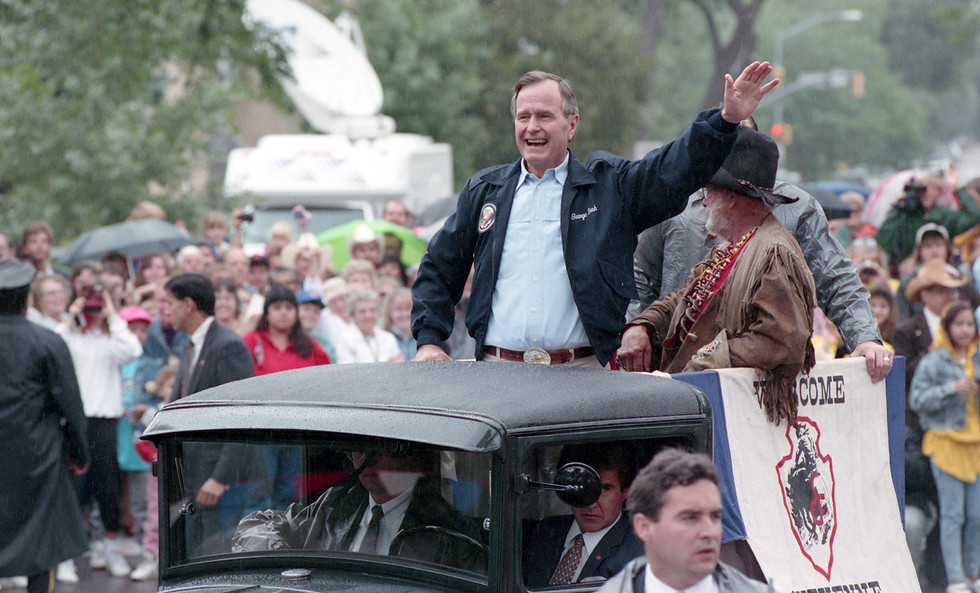
For the parade, President Bush rode in the back of the 1930 Ford Model A Truck. However, President Bush apparently did not want to ride in the truck or stand on a stool in the truck’s bed (which he was instructed to use for the parade), and strongly preferred using the Presidential limo for his parade, in no small part because it was a rainy, overcast day (in Bush’s behind the scenes notes, aides wrote that the Presidential limos would be used in the event that it rained). Dan Greer, a member of the Oak Spokes and the owner of the Model A truck, had to drive it out to Air Force One to deliver it to the Secret Service. When he got there, Secret Service agents met him and they struck up a friendly conversation. According to Dan, the Secret Service team was made up of some of the nicest guys he had ever dealt with. As they talked, the cargo plane that accompanies Air Force One was unloading the Presidential limos onto the tarmac. When Dan took an interest in them, the Secret Service quickly took Dan over to them and gave him a full, close-up tour of the limos and some of their features. This impromptu tour made Dan’s whole day and Dan was understandably in a very good mood when he got back home to tell his wife about what had happened.
When the truck was getting ready for use in the parade, it caused a major delay. The truck (being an old Model A) could only be started with a crank in the front of the vehicle. No one on the Secret Service detail knew how to start it and were unsuccessful in all of their attempts. Thus, the Secret Service began paging Dan Greer to get him to come and start the car for them. Before leaving the car with the Secret Service, Dan Greer had been offered VIP tickets to the viewing platform for the parade since he was allowing the use of his car for the President. However, since it was rainy and he already had to deliver the car, where he had gotten to look at the Presidential limos, Dan decided the extra chance to view the President in his car wasn’t worth it and that he’d skip the parade. When his pager started buzzing, Dan assumed it was from people wondering where he was and whether he would be using his VIP seat on the platform, so he ignored many following pager calls because of that assumption. After a long delay, Dan decided to respond to his still ringing pager and call back, at which time the Secret Service told him they needed him back to the parade route immediately. Dan was quickly escorted to the Secret Service trailer in the staging area and then to the Model A truck, where he promptly got it started, at which time the parade then began to get underway.
The short three-block parade route began with Bush’s motorcade turning right onto Capitol Avenue from W 22nd Street, and then began slowly driving down Capitol Avenue, then a left turn onto W 24th Street (just in front of the Capitol Building), and then a right turn onto Carey Avenue, which would get him directly to the speaking platform set up for him (located on the western side of the Capitol Building, in front of the side entrance to the building). During the parade, Bush was accompanied in the back of the Model A truck by a Secret Service agent and by a mountain man named “Mountain Man-Top of the Rockies-Timber Jack Joe Linde”. According to a news report by Jerry Seib of the Wall Street Journal and Susan Paterno of U.S. News & World Report, the mountain man’s business card said that “he is the last authentic mountain man, a trapper, philosopher and ambassador of honesty in living with your fellow man”, with his card also saying that “he is registered under the name Grey Eagle with the Sioux Indian tribe” and was a member of the National Mountain Man Society (Bush said later in his speech at the Capitol Building that the mountain man’s name was “Timber Jack” and that his dog “Toughy” accompanied them in the truck bed, and mentioned that Timber Jack hooped and hollered all the way down the parade route as he stood next to Bush). The parade for President Bush had standing crowds along the sides of the road of four or five rows deep and was heavily made up of children. A few signs were held up by the crowds along the parade route, including a woman who held a “Thanks for Life” sign, ironically in the yard of Schrader’s Funeral Home, which was located along the route.
Bush arrived at the Capitol Building’s rally site at 1:00 PM. The security at the Capitol Building for Bush’s visit was intense. As The Wyoming Eagle reported the next day in an article by Katherine Walsh:
“The Capitol west wing was shut down completely to allow the Secret Service to use the Senate as a base of operations, forcing State Auditor Jack Sidi and Secretary of State Kathy Karpan to shut down their operations for the day. The Secret Service swept the west wing periodically, smiling at the local media representatives who fought for – and won – the right to keep their west wing offices.
Several black-garbed snipers ranged themselves along the tops of the buildings surrounding the west parking lot of the Capitol. They could be seen scanning the crowds carefully with binoculars and rifle scopes. Their presence proved to be distracting for some watchers, as at times they were silhouetted against the sky over Bush’s head.
Another security feature that puzzled many was the stringing of a blue banner or tarp across Carey Avenue at 25th Street and 22nd Street at Capitol Avenue. Officials explained later that the tarps were to disrupt any rifle sight-lines for would-be assassins.
Cheyenne Police were seen arranging for the towing of vehicles from Randall Avenue and Central Avenue to nearby side streets. No warning signs were posted along the way.
A CPD dispatcher explained that the president’s motorcade route had been changed at the last minute. ‘All the vehicles were taken around the corner, and we explained to the vehicles’ owners that they did just go around the corner,’ she said.
The total cost of the tows was unknown to the dispatcher, as well as who would be footing the bill.
Security was so tight that even state officials had problems. Senate President Russell Zimmer, R-Goshen, and his wife, Ila, had problems talking their way into the Capitol Friday morning.
Zimmer laughed it off, however. ‘That’s okay. We don’t want to have another Lee Oswald on our hands.’…
The rally’s stage was strategically placed so that an American flag, which was hanging on the side of the Capitol, would be over Bush’s head as he spoke. However, the day’s rains had made the flag so wet it nearly blended in with the Capitol’s gray-brown facade.
The House chambers were alive with activity even after Bush left for his fishing trip on the Middle Crow Creek. The White House press corps took over the House for their operations. Laptop computers, microphones, and other electronic gadgetry filled the desks as reporters typed or taped their pieces.” (*This press corps consisted of approximately 65 men and women, who were (besides working away in the House chambers) also relaxing, helping themselves to sandwiches and coffee that had been provided to them, and telling local reporters there about the usual strains, benefits, lifestyles, and realities of being a Washington press corps member for the President (especially for Bush, who had a much busier average travel schedule than President Reagan previously had). They had time to do this in Cheyenne because according to them, “the president’s stop in Cheyenne was not, compared to their usual fare, very newsworthy”. (Among the press corps members in the House chambers that day was Leslie Stahl (then with Face the Nation), who was seen talking on two phones at once in the chambers).
By 1:10 PM, Jerry Jessen and then Dick Hartman were delivering brief remarks on the stage. Then, President Bush was introduced by Governor Sullivan, and at 1:15 PM, President Bush began addressing approximately 15,000 people attending the rally (newspapers say that in reality only at least a few thousand attended his speech, probably lower than original pre-estimates of around 20,000 due to the weather), some of whom had waited for several hours in their spots before Bush arrived, but nonetheless reported to newspapers later that they enjoyed Bush and the experience of seeing him up close in Cheyenne. Many who attended the rally also brought their children with them so they could also see the President in Cheyenne.
In his speech, President Bush’s mainly spoke about Wyoming’s clean environment, its celebration of the Western way of life (as Bush said, Wyoming is “the closest state we have to the Old West”), Wyoming’s upholding of old-fashioned values such as self-reliance, a love of freedom, a love of faith, and the state’s emphasis on neighborly kindness and community service (where he mentioned that he had recently named the Cheyenne Botanic Gardens and the Yellowstone Recovery Corps as America’s Daily Points of Light winners). In the speech, Bush also gave shoutouts to his own famous distaste of broccoli, the Casper Troopers (who had played a quick outdoor performance for him earlier, in the rain), former Governors Cliff Hanson and Stan Hathaway and their wives (among others). Bush also spoke about his approval of the state’s rejection of federal government overreach, applauded Wyoming’s great educational standings in the nation, argued for voluntary prayer to be restored to America’s classrooms, and argued for a constitutional amendment to protect American flags from desecration (from protests or otherwise). Bush closed by briefly talking about “The Spirit of Wyoming” statue by Edward Fraughton that had been newly installed near the Capitol Building and about the Wyoming Centennial. At 1:29 PM, Bush concluded his remarks at the Capitol. After Bush left the Capitol Building, a crew would begin disassembling the stage he spoke on.
At 1:43 PM, Bush boarded his motorcade and made his way to F.E. Warren AFB, where he arrived at 1:50 PM. At Warren AFB, Bush was met by the Wing Commander of the base, Colonel Richard Farkas, and they then began a tour of the base’s Peacekeeper (MX) and Minuteman missile training silos, four stories underground. Al Simpson accompanied Bush to Warren AFB and on the tour of its training facilities, briefing the Presidential party on the base and its good relationship with the community of Cheyenne. Asked about why Bush visited, Bush’s Press Secretary Marlin Fitzwater stated at Warren AFB that “General Scowcroft (Bush’s National Security Advisor) thought we should visit one, for the morale of the troops and two, to make a point in light of the budget negotiations.” After the tour, Bush was taken to the toast lectern to give brief remarks to the 100-150 troops present at the speech area at the base in drizzling rain at 2:14 PM. In those remarks, Bush stated:
“As we strive for strength and stability, we must maintain an effective deterrent – especially in the face of continuing across-the-board modernization of Soviet strategic forces. Now, this won’t be easy in the fiscal environment that we face now. We all recognize that we must get the deficit under control and the defense will contribute its share. But I don’t want defense to contribute more than its share. I’m asking Congress to hold the line at the painful reduction in the defense budget set down by the Senate Arms Services Committee earlier this week.
One point I want to emphasize today is that the deeper and more painful cuts in the defense budget, the greater is my need for flexibility from Congress in order to manage these funds. We must have an orderly build-down, not some kind of a fire sale. I especially need that flexibility so that the bedrock of the military is highly trained, highly motivated and exceptionally dedicated men and women, people such as you, will be protected.”
Bush then finished his remarks by 2:19 PM and went out to shake hands with and meet some of the troops in the crowd. Senator Al Simpson also met and greeted troops as Bush did at the base. Bush then got into his limo at 2:22 PM, speaking to the troops through the limo’s loudspeaker as he prepared to depart, saying things such as “Thanks a lot, guys”. His motorcade then proceeded to Middle Crow Creek to a fishing area for a private afternoon of relaxing fishing. Before departing Warren AFB, Ann Devroy of the Washington Post reported that a fellow reporter “could not keep himself from shouting a question at Simpson on the kind of bait Bush and party plan to use fishing. There ensued a lengthy Simpson soliloquy on the advantages of various lure and bait which you may have heard and wondered about”.
At the fishing area on Middle Crow Creek, Bush (still accompanied by Senator Simpson) was met and joined by Joe White, the Deputy Director of Wyoming Game and Fish, Larry Garrett, the property owner of the area they were fishing in, and Dick Haag, a personal friend of Senator Al Simpson at 3:01 PM. The party got in their fishing gear at a nearby camper van and fished privately for roughly 2 hours 45 minutes. The weather while the President fished was 55 degrees Fahrenheit, damp and cold, with persistent drizzling and occasional showers. At 4:21 PM, Bush had a call via satellite phone on Middle Crow Creek with John Sununu (the White House Chief of Staff) as Secret Service agents looked on in guard on top of nearby rock formations. At 5:39 PM, Bush and Simpson boarded the motorcade and departed for the Wyoming Air National Guard Base. At 6:18 PM, the motorcade arrived near Air Force One. Among the people present when Bush departed were Senator Al Simpson, Congressman Craig Thomas, and the commander of the Wyoming Air National Guard (among other dignitaries). On the tarmac, Bush and Simpson showed off their catches of the day (one fish for each of them). Bush then said his farewells to the party, gave Al Simpson his fish, and boarded Air Force One. Al Simpson then went to the press to continue showing off both fishes on the tarmac. Air Force One departed the airport at 6:36 PM.
Near the end of Bush’s visit, Associate Justice of the Supreme Court William Brennan Jr. submitted a letter of resignation to President Bush for health and age reasons (he was 84 at the time of his resignation) after 34 years on the Supreme Court. On the plane ride from Cheyenne to Washington D.C., Bush spoke to Brennan on the telephone about his retirement and then held an impromptu news conference with reporters on the plane to make the announcement of Justice Brennan’s retirement and to take some questions. Bush would tell the reporters on Air Force One: “Obviously, his resignation is accepted. I also thank him for his distinguished service to the United States” and then said that he and his top aides would meet the next morning to “start the process of finding a successor”. This would be Bush’s first opportunity to name a new Supreme Court Justice in his term of office and Bush would eventually replace Brennan with David Souter (who would eventually be replaced by Sonia Sotomayor).
*Note: Al Simpson was a close personal friend of George Bush, so much so that Bush instructed Simpson to give one of the eulogies at his state funeral at the National Cathedral, which took place in Washington D.C. in 2018. Al Simpson died in 2025.
*This visit by President Bush is (to date) the latest visit by a U.S. President to Cheyenne (36 years ago in July 2026).
*Peggy Dooley was the White House Researcher at the time and compiled much of the info on Cheyenne for President Bush to know and use for his speech.
Credits and Sources
Sources for George H.W. Bush’s Visit Write-Up include:
The George H. W. Bush Presidential Library and Museum
Joe McKee
Pat Greer
Ryan Whitehead
The Wyoming Eagle